
Item Description
This aerial lift safety toolbox talk gives your crew a clear, five-minute conversation about one of the most common ways to get hurt at height: working from a lift basket without being tied off.
Aerial lifts reach work that ladders and scaffolds often cannot, but the hazards are real. Workers can fall from the basket, be thrown out when the lift jolts, get crushed against overhead steel, or contact energized power lines. Wind, soft ground, slopes and overloaded platforms add tip-over risk.
The talk is built around the slogan "Tie Off Before You Rise." It walks your crew through the pre-use inspection of controls, guardrails, tires, hoses and the emergency lowering system. It covers wearing a harness or restraint tied to the manufacturer's anchor point, keeping both feet on the platform floor, and never climbing on rails or standing on planks or boxes to gain height. It also covers checking overhead for power lines, staying within the load rating, and using a ground person.
The story features Unsafe Dave, who leans out over the guardrail of a boom lift to reach a conduit clamp without his harness tied off. When the basket jolts, he grabs the rail. Safety Sam's call, "No tie-off, no ride," gives your crew a simple rule to remember and a way to start talking about what they do on their own lifts.
It is written for safety managers, superintendents and foremen who need a ready-to-use talk for the start of a shift. Read it aloud, ask the discussion questions, and send your crew up with the right habits.
What this toolbox talk covers
- Inspect the lift before every shift starts.
- Wear a harness tied off to the basket anchor.
- Keep both feet on the platform floor always.
- Check overhead for power lines before raising.
- Never climb on the guardrails or midrail.
- Stay within the rated load limit of the lift.
DID YOU KNOW?
Falls, tip-overs, and electrocution are the leading causes of serious aerial lift injuries. Many happen when workers leave the platform or skip the tie-off. A harness anchored inside the basket can keep a bad bounce, jolt, or sudden stop from becoming a fatal fall.
Common questions
Do you have to wear a harness in a scissor lift?
Requirements depend on the lift type and the manufacturer's instructions, so follow the manual and your site rules. Boom lifts require a harness or restraint tied to the manufacturer's anchor point, and guardrails must always be in place and the gate closed.
How far should an aerial lift stay from power lines?
Keep at least 10 feet from power lines up to 50 kV, and more for higher voltages. Always check overhead for lines before raising the platform.
What should be checked in an aerial lift pre-use inspection?
Inspect the controls, guardrails, tires, hoses and emergency lowering system before every shift. Tag out and do not use any lift with defects.
Includes the print-ready toolbox talk and a matching safety poster, in English and Spanish, for daily jobsite safety meetings.
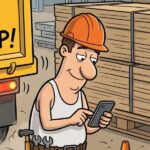
A five-minute toolbox talk can prevent a five-week recovery—take the time or take the consequences!
Included Files:
- Toolbox Talk (PDF)
- English + Spanish
- Print-Ready Safety Poster
- Sign-in/Attendance Sheet
- Facilitator Tips
